Most software synthesizers are written to ship. This one was written to a standard — the kind of discipline reserved for systems that are not permitted to fail. No memory is allocated while it plays. Its timing never drifts. A single voice can fault without taking down the show, and nothing it does can damage your speakers or crash your session.
Behind that engineering is the part you actually hear: a full modular voice — oscillators, filters, envelopes, effects — and a factory bank that runs from glassy electric pianos to snarling acid lines. It is small enough to run light on a laptop and serious enough to trust on stage.
You don't have to understand how it's built to feel that it's built well.
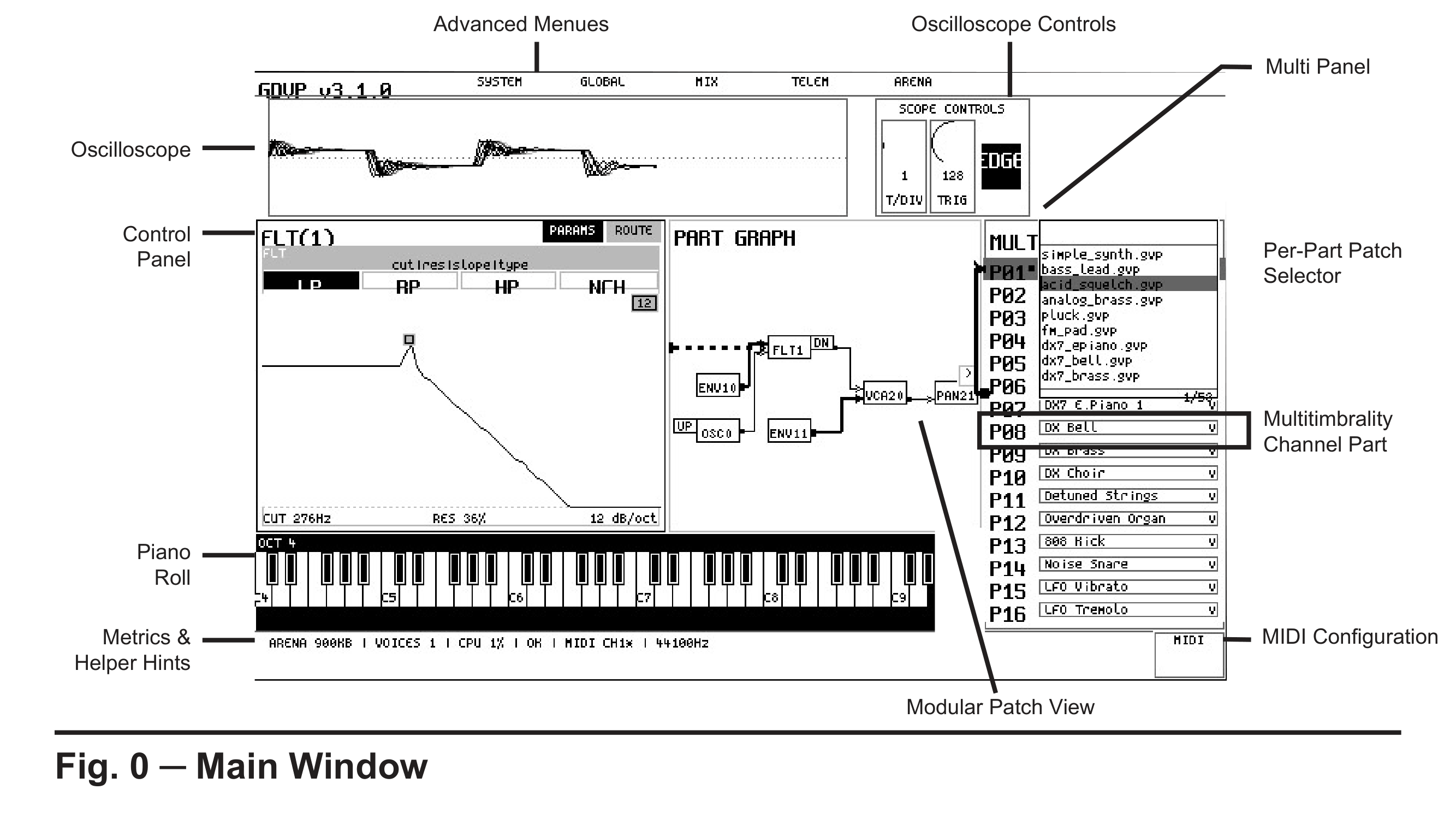
Fig. 0 — the main window
One window, no menus to get lost in. The selected node's controls sit on the left, the whole patch is a graph in the middle, your 16 parts are on the right, and the live scope runs across the top.
- Advanced menus
- System, Global, Mix, Telemetry and Arena views.
- Oscilloscope + controls
- Live waveform with time/division, trigger level and edge.
- Multi panel
- All 16 multitimbral parts at a glance.
- Control panel
- The selected node's parameters — here a filter: cutoff, resonance, slope and type, with a live response curve.
- Modular patch view
- The node graph — oscillators, envelopes, filter, VCA, pan — wired on a grid.
- Per-part patch selector
- Load any factory or saved patch onto a part.
- Multitimbral channel part
- Per-part name and MIDI channel routing, P01–P16.
- Piano roll
- Held notes; play from a MIDI controller or the computer keyboard.
- Metrics & helper hints
- Arena size, voice count, CPU, MIDI channel and sample rate — plus hover help.
- MIDI configuration
- Pick and connect your controller.
“Built like an instrument. Held to the standard of an autopilot.”
“If you can't trust your synth the way you'd trust an autopilot, it isn't really professional gear. I wanted to build the warm, expressive instrument I wanted to play — and refuse to compromise on whether it would hold up when it mattered.”— François-Xavier Briollais, the instrument's author
Inside the voice
Inner features
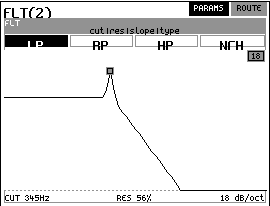
- Four modes: low-pass, band-pass, high-pass, notch.
- True 6 / 12 / 18 / 24 dB-per-octave slopes via cascaded sections.
- Resonance up to self-oscillation — stable across the entire range.
- Audio-rate cutoff FM with 2× oversampling for clean modulation.
- Per-voice tone shaping, with a pre-gain drive into the saturation stage.
Sonic character
From gentle tone-shaping to a screaming resonant lead. Push resonance into self-oscillation and it sings a stable sine at the cutoff instead of distorting or blowing up — the resonance is soft-saturated to a musical ceiling, so the whole cutoff-and-resonance range stays playable.
In a word
- It was built so that a crash mid-set is not a risk you carry.
- A failed voice is muted in silence, not screamed through your monitors.
- The engine holds the same timing on the thousandth note as the first.
- Your session is protected by the same kind of safeguards used in aerospace software.
The instrument, feature by feature
128 notes at once, and it never stops to think. The engine does the same amount of work every single cycle, so there are no surprise stalls, no timing hiccups, no glitches when the part gets busy.
128-voice polyphony · constant-time execution · under 10% CPU at full load.
The factory bank
From DX electric pianos to acid squelch, French-touch leads to 808s — the factory bank is a working instrument out of the box, and every sound opens up for you to make it yours.
Glassy DX-style electric pianos, FM bells, marimba, choir, and brass — faithful four-operator reconstructions of the sounds that defined an era.
dx7_epiano · dx7_bell · dx7_marimba · dx7_choir · dx7_brass · analog_brass · overdriven_organ
The engineering
Every bit of the engineering terminates in something you can feel:
- A patch sounds the same every time you load it, on any machine.
- No dropouts, no stutter, no slowdown over a long set.
- Push the filter to the edge and it sings instead of breaking.
- A fault mutes one voice; the session never dies; the speakers stay safe.
Who it’s for
Fixed-point determinism: the same patch, sample-for-sample, on every machine.
Specifications
| Capability | What it means for you |
|---|---|
| 128-voice polyphony | Stack big chords, long pads, and busy parts without running out of notes. |
| Under 10% CPU at full load | Leaves your machine free for everything else in the session. |
| Never allocates memory while playing | No stutters, no hiccups, no creeping slowdown over a long set. |
| Fixed, constant timing | The instrument feels identical on note one and note ten thousand. |
| Fail-safe error system | A fault mutes one voice; it never crashes the session. |
| Acoustic kill-switch | Any emergency goes to silence first — your speakers are safe. |
| Fixed-point engine | Repeatable, drift-free sound; a saved patch always sounds the same. |
| Stable self-oscillating filter | Push the filter to its limit and it sings instead of breaking. |
| Real-time scope + spectrum | Watch your signal and modulation move as you play. |
| 16 multitimbral parts | Build layered, multi-instrument setups in one instance. |
| Standalone + VST3 | Use it on its own or inside your DAW — one license covers both. |
| Mac & Windows | Universal on macOS (Intel + Apple Silicon); native on Windows x64. |
| Factory patch bank | Ready-to-play sounds across keys, bass, leads, pads, and drums. |
| Open, editable patches | Every sound is yours to see, tweak, and rebuild. |
Get it
Founder pricing
The complete instrument, at half price, for the people who show up first.
Claim your founder license — $75
This is the founder window. When it closes, the price is $150. The free demo is the complete instrument, with an occasional reminder tone until you unlock it. No account required. No subscription. Licensed to you, bound to your machine.
How unlocking works
| 1 | Download and play — the demo is the whole instrument. |
| 2 | When you're ready, send your Machine ID and we issue your license. |
| 3 | Drop the license file on the window. The reminder tone stops. Done. |